My Story
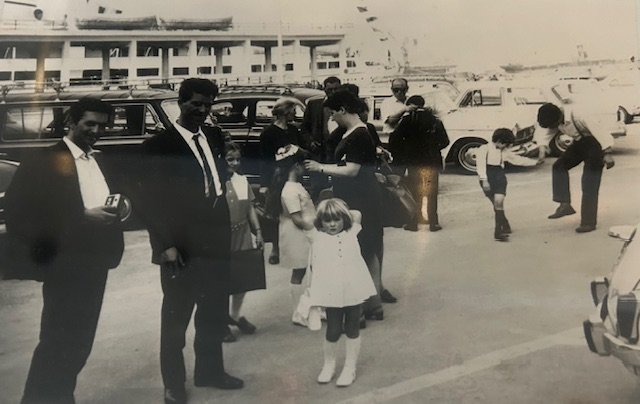
I was born in Campania, just southeast of Naples. At the age of 4, I sailed with my family on one of the last transatlantic crossings made by the SS Raffaello in the 1960s as three generations moved to the US. I was raised in Brooklyn, and my heritage lives on within me.
Madre Lingua, My mother tongue. Honored to be a native daughter of this land & live within beautiful hearts of my Napulitano people
I was born under the shadow of Vesuvio,
in a city where every street, every stone, every song carries centuries of history. When my parents immigrated us to Brooklyn in 1968, they brought not just memories, but also my language — ’onapulitano — the language of my heart.
In Italy, they call it a dialetto, so it doesn’t have legal protection like Italian. But UNESCO and the Council of Europe recognize it as a language of cultural heritage. And honestly, Nun ce ne importa. We don’t need anyone to tell us its value.
People often ask me if it’s “just Italian with an accent.” Ma che staje dicenn’? Napulitano is its own language. It was born from Latin, Greek, and Oscan, and over the centuries it absorbed French, Catalan, and Spanish. Every parola we use carries centuries of history.
Salvatore Di Giacomo gave us verses full of longing, Eduardo De Filippo put the soul of Napoli on stage, and Totò, ’o principe ’e ’a risata, taught us to laugh even through hardship. Sophia Loren...musicians like Roberto Murolo , Enrico Caruso, Roberto Murolo, Pino Daniele and Renato Carosone carried our songs to the world. And today, director Paolo Sorrentino, and Elena Ferrante, show us Naples the way it truly is
— raw, beautiful, alive.
Te voglio bene assaje, the way my mother taught me, I feel like I’m carrying Napoli in my bones. The language survives because of love, because of memory, because of that inimitabile spirito napulitano.
No matter how far I go, every time I speak in napulitano, I feel my city inside me — my mamma’s spirit, the whispers of my nonna, warning us about malocchio or her throwing salt behind our backs to chase away bad luck. È ’a lingua d’ ’a famiglia,
d’ ’a strada, d’ ’a vita. E chest’è Napule.
The term Ferragosto (August 15) comes from the Latin term Feriae Augusti (“Augustus' Holidays”), as the celebration was established by the emperor Augustusin 18 BC. Ferraragosto is born out of that, inspired by the traditional summer holiday and my last name, which shares the same prefix.
- Laura Ferrara